
International FrameNet Workshop 2027 (IFNW 2027)
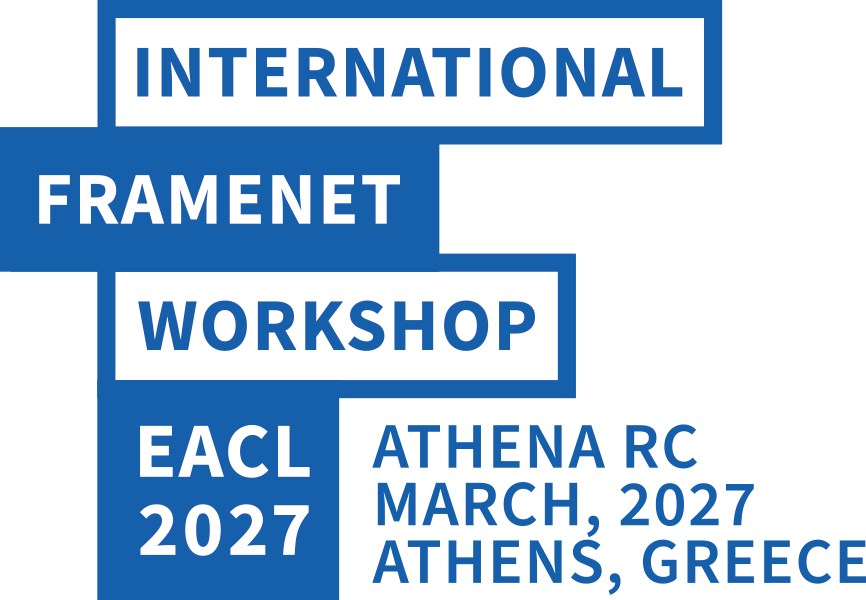
The 7th International FrameNet Workshop 2027 (IFNW 2027): “Fame-Based Language Resources and Large Language Models Revisited,” will be held on March 9th, 2027, in collocation with EACL 2027, at ATHENA Research Center. IFNW2027 aims to be a forum for researchers and practitioners working in computational linguistics, NLP, cognitive science, linguistics, translatology and multimodal and multilingual applications. The workshop aims to foster an interdisciplinary dialog on recent advances in frame semantics, FrameNets, and frame-based approaches to language and knowledge representation, as well as their applications and explainability power in contemporary NLP and AI.
IFNW 2027 is a SIGLEX-endorsed event and follows from six previous editions: one in 2025, held in Yokohama, Japan, one in 2023, held in Düsseldorf, Germany, one in 2020, held online, one in 2018, held in Miyazaki, Japan, one in 2016, held in Juiz de Fora, Brazil, and one in 2013, held in Berkeley, USA.
Important dates
Abstract submission deadline: Dec. 15th, 2026 (GMT-12)
Author notification: Jan. 5th, 2027
Camera-ready papers due: Jan. 19th, 2027
Pre-recorded video due: February 12th, 2027
Workshop date: TBD (between Mar. 9-14th, 2027)
Call for papers
Grounded in Fillmore’s theory of Frame Semantics, the FrameNet (FN) approach has been established as a cognitively motivated modeling of meaning representation that captures the conceptual structures underlying language, with the Berkeley FrameNet as its first and best-known incarnation. The explicit representation of semantic frames and frame elements has made FNs a cornerstone for lexical semantics and knowledge representation, supporting research in semantic role labeling, information extraction, question answering, multilingual and multimodal lexical resources (LRs), and healthcare.
The emergence of Large Language Models (LLMs) has created new opportunities and challenges for semantic and cognitive representations. While foundation models largely rely on implicit meaning representations, FNs provide structured, culturally and cognitively grounded semantics that may improve the LLM performance. At the same time, LLMs offer new opportunities to boost the (semi)automatic construction, extension, and adaptation of multilingual frame-based resources.
Against this background, we propose the International FrameNet Workshop 2027 (IFNW2027) as a forum for researchers and practitioners working in computational linguistics, NLP, cognitive science, linguistics, translatology and multimodal and multilingual applications. The workshop aims to foster an interdisciplinary dialog on recent advances in frame semantics, FrameNets, and frame-based approaches to language and knowledge representation, as well as their applications and explainability power in contemporary NLP and AI. For the 2027 edition, we particularly encourage submissions on, but not limited to, the following topics:
LLMs augmentation with frame-based LRs;
Frame and construction-based LR creation and expansion using LLMs;
Combination of frame-based LRs and LLMs/AI for domain-specific applications;
Applicaton of frame-based LRs in Digital Humanities, Computational Social Sciences and Education;
Global FrameNet Association initiatives and FN alignment;
Neuro-symbolic and trustworthy AI with FNs;
Frame-annotated datasets;
Survey papers on the combination of FNs/frame-based LRs and LLMs/AI.
The workshop welcomes archival and non-archival submissions, in the form of either long (8 pages) or short (4 pages) papers, allowing authors to present either unpublished work or previously published research that could be of interest to the community.
Submission Guidelines
Submission to IFNW 2027 follows, where applicable, the guidelines of EACL 2027. For archival submissions, both long and short paper submissions should follow all of the ARR submission requirements, including:
Long Papers (8 pages) and Short Papers (4 pages)
Multiple Submission Policy, Resubmission Policy, and Withdrawal Policy
ACL’s Publication Ethics Policy, and ARR’s Ethics Policy including the responsible NLP research checklist
ACL’s Disclosure Policy
Final versions of accepted papers will be given one additional page of content (up to 9 pages for long papers, up to 5 pages for short papers) to address reviewers’ comments.
For non-archival submissions, authors should indicate, in the submission page, that they want their submission to be non-archival.
Submission links will be provided soon.
Venue
ATHENA Research Center
Institute for Language and Speech Processing (ILSP)
Artemidos 6 & Epidavrou, Maroussi, 15125, Greece
Sponsors
Organizing Committee

Tiago Torrent, Federal University of Juiz de Fora, Brazil
Voula Giouli, Aristotle University of Thessaloniki, Greece
Oliver Czulo, Institut für Translatologie gGmbH, Germany
Kyoko Ohara, Keio University, Japan
Haris Papageorgiou, ATHENA Research Centre, Greece
Program Committee

Ana Ostroški Anic (Institute of Croatian Language and Linguistics, Croatia)
Frederico Belcavello (Federal University of Juiz de Fora, Brazil)
Hans Boas (UT Austin, USA)
Dana Dannélls (Gothenburg University, Sweden)
Thomas Herbst (FAU Erlangen-Nürnberg, Germany)
Marie-Claude L’Homme (University of Montréal, Canada)
Benjamin Lyngfelt (University of Gothenburg, Sweden)
Aleksandra Markovic (University of Belgrade, Serbia)
Ely Matos (Federal University of Juiz de Fora, Brazil)
Ranka Stankovic (University of Belgrade, Serbia)
Piek Vossen (VU University Amsterdam, Netherlands)
Alexander Willich (HH University Düsseldorf, Germany)